

World Cup Lessons
Are the Institutions All Right?

“Everything in Between” is about the systems, institutions, and practices that people build, “things” of a sort that sit in between us, between groups of us, between “us” and “them,” and between us and other systems and institutions that seem terribly far away: “the market,” “the state,” the universe, and so on.
In addition to my posts here, I co-host a podcast titled “Your Leadership Podcast,” which is available on Spotify and wherever fine podcasts are available. I write about law and legal education at TaxProf Blog and for several years co-hosted a podcast about technology and law titled “Your Future Law Podcast.“ My older blog about Pittsburgh and renewing cities, Pittsblog, is still available online, as is my original blog about law, technology, and governance.
Like tens of millions of people around the world, I spent much of the last five weeks glued to my screens, watching and following the World Cup.
(Sorry. That’s the “FIFA World Cup,” at least since 1970, when modern branding first kicked in to the tournament, figuratively. 1970 also was the first year that the World Cup featured the now-iconic black-and-white hexagons-and-pentagons soccer ball. The black-and-white contrast, a departure from the white balls and orange or brown balls that had been common to that point, was a tip-of-the-hat to television broadcasters that need the ball to show up on screen clearly. The ball itself, branded the “Telstar” as a link to the space age, was produced by adidas, which ever since has had the exclusive right to produce the official World Cup ball. The current FIFA/adidas ball contract runs through 2030. I once wrote about the history of the soccer ball.)
I’m “back” from soccer, or football, or “the football,” or fútbol, but the tournament and the sport are not far from my thoughts. To step in again to this space, I thought that I’d begin with some reflections. Institutional lessons from the World Cup!
There are five. Maybe I’ll have more later. Five, to start with, for now.
One: Systems matter.
Colloquially we refer to each team not as “the team” but by the name of the country the team represents. Twenty-six roster players stand in for and re-enact national identities, cultures, histories, ambitions, resentments, conflicts, and more. Which means that it is both inevitable and right to see what happens on the field (as well as in the stands and in the streets) as concrete instances of institutional concepts. When the jerseys go on and the ball starts to move, large-scale systems are paying off - or not.
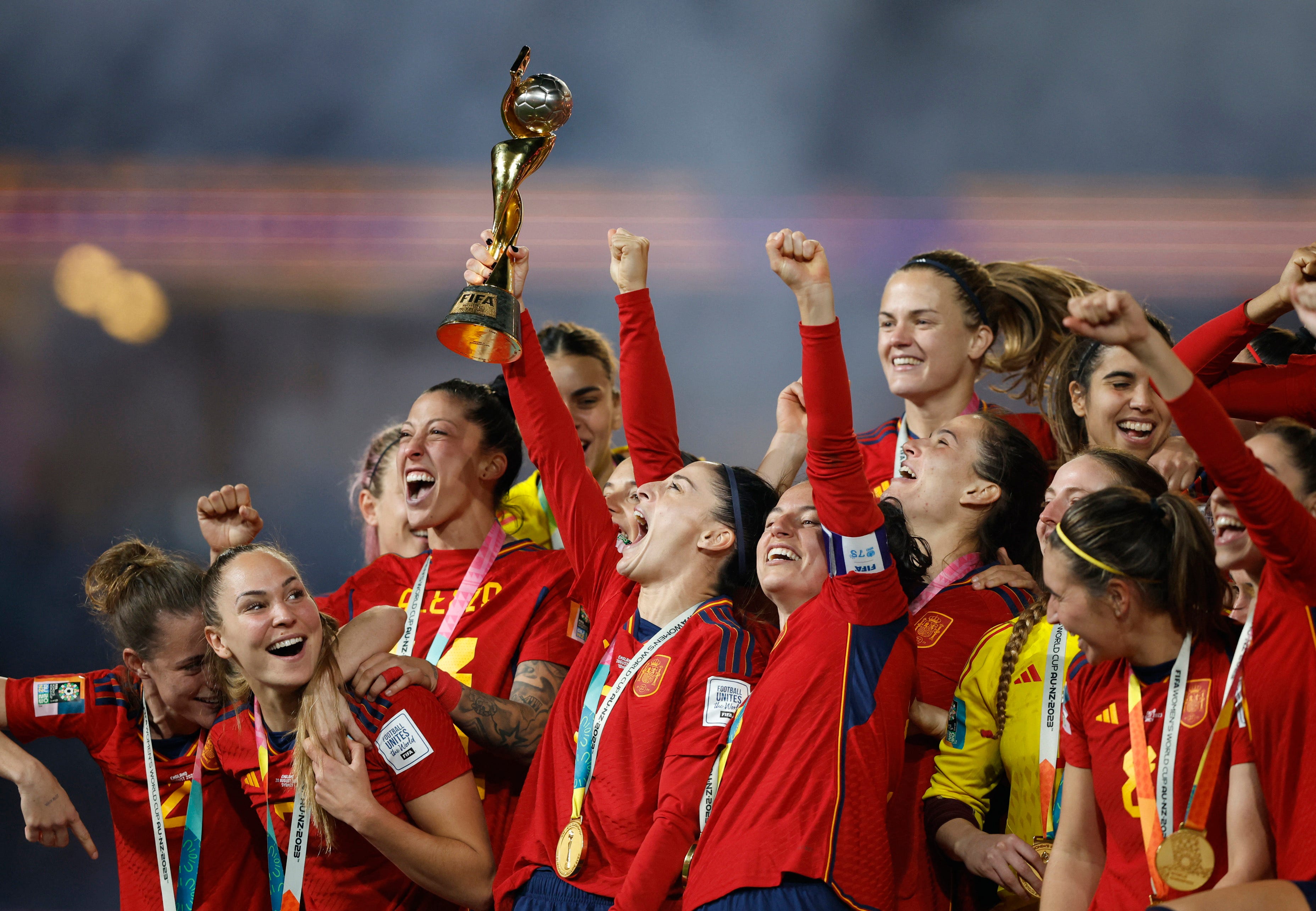
It’s easy to start with the winners: Spain. Their performance against England was a master class of touch, style, strategy, and execution. The players seemed to glide around the field; their English opponents never seemed to catch their breath, despite moments of rhythm. What was set up in advance as a clash of titans turned out to be far more one-sided, beginning to end, than the 1-0 scoreline suggested.
England?
I am referring, of course, to Spain’s victory in the final of the 2023 Women’s World Cup, a performance that was every bit as dominating, disciplined, and impressive as the win by Spain’s men’s team in last Sunday’s match against Argentina. I do not doubt for a moment that the men observed the play and the successes of their compatriots in Sydney and said to themselves, “hold my Tinto de Verano.” Rodri (more about him in a moment) et al. played a game that was in many respects a mirror image of the game that we saw from Bonmatí et al. Crisp first touches, quick one-touch and two-touch passing, rhythm, great use of space, patience, discipline in the face of physical defending, and when the opportunity arose, a lethal finish.
None of that happens, men or women, without institutional design and support and without players and managers fully participating. We say “buying in,” a phrase whose transactional implications I dislike. I’ll borrow from the 1973 Mets: “Ya Gotta Believe!”
I don’t just mean that the fans need to be all-in; I mean that the vision and values - as well as the strategies and tactics - need to be organic to just about everyone in the institution. What we see in Spain today are obvious manifestations of a commitment to a style of player development and performance, from the youth level onward through clubs and national teams, that owes its origins to a Dutchman: Johan Cruyff, who brough “Total Football” from the Netherlands to Barcelona in 1973. We saw Cruyff’s influence in the “tiki taka” style that defined Barcelona’s glory years earlier in the 21st century and that Spain rode to the 2010 World Cup title. We see it not only in Spain; we see it in Guardiola’s Manchester City career.
Which is not to say that Cruyff-derived soccer is the only way to inspire a team to great heights; we’ll see if Klopp and his “Gegenpress” can do as much for Germany as they did for Dortmund and Liverpool.
A lot of people in administration, management, and coaching had a lot to do with Spanish success along the way. But Spanish soccer had the wisdom to take inspiration from a transformative leader and to build (really, re-build what had been a notoriously underperforming system) around it. Spain has experienced some horrific soccer-related behavior in recent years, particularly surrounding the women’s national team, but on the whole the Spanish soccer federation has done a lot of things right.
Don’t get me started about Norway. Talk about national commitment, inside and outside a team, a supporters base, a state-sponsored sports system, and the country as a whole. Ro!
Two: Institutional size matters.
After the United States crashed out of the tournament in the round of 16, soccer pundits in this country returned to their favorite quadrennial hobby: speculating about what the US needs to do to compete consistently and successfully at the highest levels of international soccer.
I don’t have an answer. I’ve been following national team soccer in the US only since the mid-1970s.
I do know, however, that the country’s size - its diversity of interest and practice, its decentralized governance systems, its history of localism and narrow tribalism, its occasional commitments to inclusion, its treatment of sport as entertainment and recreation rather than as collective culture - works against it. This year’s World Cup demonstrated yet again that smaller countries can, in the right circumstances, marshal history and practice (and more than a little rule arbitrage, sometimes) to “outperform.” Norway and Switzerland (with national youth development systems)! But also Uruguay (where soccer is a national obsession), Croatia (where it is fundamental to national identity), Morocco (which took full advantage of liberal player eligibility rules), and of course the Blue Sharks of Cabo Verde (finally, an obviously positive use case for LinkedIn!).
Yes, youth soccer in the US operates on a pay-to-play model, once you get past recreational soccer. But that’s the least of it, in a way. Professional soccer clubs in other countries may “sign” kids to contracts even before they reach middle school. My hunch is that the US simply has too many things going on - in education, entertainment, community - for the country to develop the sort of single-mindedness about soccer that international success demands. The US can be more consistently competitive than it has been, and it has demonstrated that competitiveness over the last 25 years. Why? Because the most talented American youth have figured out how to steer around the entertainment model that dominates US pro sports and have shipped off to other countries, where soccer is taken more seriously.
My takeaway is that large systems and institutions need to be “decomposable,” or “nearly decomposable” to borrow a concept from Herb Simon. Meaning: large scale complex systems function best if they can be broken into hierarchies of small systems that operate largely independently of one another in the short term and that are coordinated thoughtfully over the longer term. “Youth soccer in the US shouldn’t be pay-to-play” is too crude a descriptor. Recreational soccer doesn’t interoperate productively with competitive youth soccer. Competitive youth soccer that feeds into high school soccer doesn’t interoperate productively with independent youth soccer clubs. NCAA and other college soccer doesn’t interoperate productively with professional leagues in the US. Not all of the professional leagues in the US get along well with one another. And USSoccer, the national federation that is nominally “in charge” of (almost) all of the game in this country, has no clear or consistent vision for the future of the game. Look no farther than its track record in hiring and firing national team coaches.
Three: The first touch matters.
I mean that both literally and figuratively.
Literally in the sense that players and teams that performed consistently well used their first touch of the ball to incredibly positive effect. Sometimes I will watch a soccer game simply to focus on that first touch. A good first touch sets up a player for a pass or a shot or a dribble past or through another player; a poor first touch sets up a player for giving the ball away, or a poor shot. Spain: amazing first touch. The US: inconsistent first touch.
Figuratively in the sense the soccer, like any team sport, is in the end an institutional formation. It’s about the people. Watching this World Cup, you could sense - even through the screen - that some teams cohered, inter-personally, and some did not, or at least less so.
To the extent that the US team succeeded during group play - a run of performance that in my view vastly exceeded the team’s actual technical talent - Mauricio Pocchetino nurtured that success by persuading his players to buy his “why not us?” schtick. Didier Dechamps and France had a great bond. Ståle Solbakken had it with Norway. Luis de la Fuente and Spain, to be sure. Carlo Ancelotti was brought in to lead Brazil for precisely this reason: his leadership and success records are unimpeachable. But he could not get Brazil’s players on the same page.
Neither could England’s Thomas Tuchel, which tells me that “first touch” influence doesn’t always come from the coach or the manager. England’s on-field leadership was stellar even if Tuchel’s hand on the tiller was unreliable. That includes Kane, Rice, and Anderson; Pickford had a great run in goal. That’s a backbone to envy.
For my money, though, Jude Bellingham was without question the breakout performer at this World Cup. He doesn’t have Erling Haaland’s charisma; he doesn’t have Kylian Mbappé’s flair, and he doesn’t have Yamine Lamal’s “next big thing” celebrity. What Bellingham has is the power to simply take over the game. Rewind the last 60 seconds of the third-place “bronze” match between England and France, which was as entertaining and mesmerizing a soccer game as most people ever have seen or will see. By the end of the match, France could sense that a tying goal were in their grasp. And then Bellingham, a late substitute for England, seized a loose ball in midfield, drove the remaining length of the pitch, and slotted the ball home. Whistle. England win.
If England had made the final, Bellingham may have ended up with the Golden Ball, as player of the tournament.
Instead, that honor went to Rodri, who did two remarkable things in my “first touch” characterization.
One: as a central midfielder - and mostly as a defensive central midfielder - he conducted Spain on the field. And I’m using “conducted” in a figuratively musical sense. Individual players had their roles and their moments; like all soccer players, they were improvising around a set of themes. But at his best, Rodri made sure that everyone was playing from the same score. He is the sort of player that I want to focus on for 90 minutes, and that I often did. His first touch was consistently sound.
And two: he did all of this after coming back from an ACL. Modern surgery and rehab being what they are, everyone knows that an ACL reconstruction is not the end of a career as it once was. Everyone knows that the goal of coming back from an ACL is to come back to the game at the same level that the player had pre-injury. And everyone knows that reaching that goal is nearly impossible. Time, age, and scar tissue inevitably take their tolls, even in the near term. Ask Virgil van Dijk, who came back from an ACL but who has never been the dominant force that he was before. But Rodri has done it. To me, with two ACL reconstructions behind me, that’s incredible.
Four: Institutional performance starts and ends with discipline and resilience.
Heading into Sunday’s final, every experienced soccer watcher on the planet hoped for a reprise of the style of match that characterized the last hour of the 2022 final between Argentina and France: thrilling end to end attacking soccer.
What we got was, instead, a reprise of a long-standing Argentine tactic: bullying, physical soccer designed not to inspire but instead to deflate. As it often is, Argentina was comfortable without the ball. Let Spain push the ball around; even let Spain take some shots. That’s what Martinez is for, in goal. (And as everyone saw, Martinez played an amazing game.) Little of what we saw from Argentina on Sunday came as a surprise (or should have come as a surprise) to observers whose knowledge of soccer extends beyond the Summer of 2026.
Argentina have the passion that defines the tango and the blue-and-white jersey - a passion for success that may not be equaled in all of soccer - plus a ton of technical talent, and the most gifted left foot in the history of soccer. But Argentina brought more than all of that to this tournament, as it almost always does. Argentina pushed and bullied its way to the conclusion of several matches, holding out for a moment of opportunity that Messi or Fernandez might seize. And seize they did.
Spain, for its part, knew that this was coming. And they knew that even more of it was coming in the second half of Sunday’s match. (Still more came even after the final whistle, and Spain were celebrating as the winners.)
And Spain said, to itself: we know who we are, and we will play our game, and we will not be knocked off our rhythm by bullying and physicality. That’s discipline, and it goes back to vision and values as well as strategies, tactics, and first-touch skills. Knock Spain down, and Spain will get up. That’s resilience.
UCLA basketball coaching legend John Wooden is associated with a saying that applies here: “How you practice is how you play.” Spain didn’t have to invent what it demonstrated in this World Cup, in the final or earlier. They did that work before the tournament started. So did all of the teams that thrived into the late rounds.
Five: Institutions play by the rules, until the rules run out.
Croatia would like a word. Egypt would like a word. Maybe the United States would like a word. Maybe Germany would like a word.
It’s difficult to imagine any of those teams advancing more deeply into the tournament and then beating Spain. In my view, Spain were simply that good.
But … Croatia were denied a crucial goal because a technology of adjudication suggested that a ball touched a player’s hair but not his scalp. Egypt were denied one of the great goals of the tournament because the referee figuratively “re-wound the tape” of play to a point far earlier than many observers thought fair. The US “benefited” from a FIFA-derived ruling that restored a star striker to the field and that simultaneously motivated their opponents (Belgium) to greater heights. Germany, like Croatia and Egypt, were denied a goal based on a questionable VAR (Video Assistant Referee) judgment.
Contrary to a lot of popular understanding, VAR (or “the VAR”) is not a computer. Computers and computer algorithms are not deciding whether a player is offside, or whether a player handled the ball or committed an offense worthy of a caution or ejection, or whether a goal should or should not stand.
Humans are making those decisions. Which is to say that humans have incorporated computers and computer algorithms into their decision-making processes inartfully, to say the least, and in ways that lead many people, including many thoughtful, experienced people, to anguish over hyper-technical interpretations of the Laws of the Game, corruption of the game by unseen and unaccountable influences, and radical inconsistencies in officiating practice that are, in some tellings, far worse than the “ordinary” inconsistencies in refereeing that soccer has lived with for more than a century.
But remember that the great Uruguayan writer Galeano, in “Soccer in Sun and Shadow,” called the referee a “dictator.” One man. His law. No appeal.
The problem, dear Brutus, lies not with VAR, but with us. Broadcasting plus social media plus Big Data analytics plus various levels of anxiety about “fairness” and “justice” - not to mention national and community identities - have combined in our collective imaginations to expect levels of consistency, transparency, and accountability in referee decision-making that simply cannot be achieved. To demand them, really.
There is a long-standing line of commentary in response that argues, in effect, that the expecting and the demanding are part of the theater of the game. If we all had nothing to argue about, then why would we watch, or play, or care? Refereeing decisions become fuel for identity formation.
There is more to it than that, I think. Wanting referees and refereeing to be “better” is natural and understandable, even if we will disagree about what we mean by “better.” There is a hint of Kurt Gödel here: the more perfect and complete our technical systems become, the more obviously their limitations will stand out. A fully-formed, complete system of adjudication that answers all questions fully, accurately, and consistently is an impossibility.
We are arguing, instead, over second best. What do we want, knowing that we’ll never get everything that we want? We might imagine a world in which human referees disappear entirely, and all questions of offside, handball, violent conduct, and goal-or-no-goal are decided by machine, instantly and automatically and - in principle - consistently with and across games. How about a network of surveillance drones, flying about the field (sorry about that, Norway), “adjudicating” conflicts on (and off!) the field more or less instantaneously and transmitting signals wirelessly to the (sensor-enabled) soccer ball. Sounds and colors in and on the ball would indicate possession, free kicks, cautions and ejections, and so on.
Is that a world we would want? That we would enjoy?
Soccer might become more like tennis, where line judges have disappeared from major tournaments and the chair umpire’s job is mostly to announce the scoring.
Or, we might return to some earlier “golden age” of gentlemen-adjudication. Trust the elite experts who invented the sport, or so say they. Soccer might revert to something like golf, where the judgments of unaided human officiating judgment are still front-and-center. Better?
I wrote about the VAR at length, here. (There, but not here, I wrote a bit about where the rules come from.) Again: I have no solutions. I’m just there, and here, to suggest that we work together to figure out the world in all of its complexity.
Thanks for sticking with me. And for welcoming me back!