

Give Us a Game
The Institution of All Institutions


“Everything in Between” is about the systems, institutions, and practices that people build, “things” of a sort that sit in between us, between groups of us, between “us” and “them,” and between us and other systems and institutions that seem terribly far away: “the market,” “the state,” the universe, and so on.
In addition to my posts here, I co-host a podcast titled “Your Leadership Podcast,” which is available on Spotify and wherever fine podcasts are available. I write about law and legal education at TaxProf Blog and for several years co-hosted a podcast about technology and law titled “Your Future Law Podcast.“ My older blog about Pittsburgh and renewing cities, Pittsblog, is still available online, as is my original blog about law, technology, and governance.
Today I take a detour, away from writing about higher education and cities and knowledge commons and toward the institution that for the next month or so will capture a significant amount of attention and interest from essentially the entire population of Earth: the finals of the World Cup.
I start with three soccer geek footnotes:
First, I am unapologetic in using the words “soccer” and “football” interchangeably. “Soccer” is a perfectly good English word for the sport, meaning “England English” not simply “English language.” The word soccer was invented by the English and used regularly in England for decades. The word shortens the phrase “Association football,” which referred to the game organized under the auspices of the Football Association (FA) in the 1860s in England. “Association football” was distinguished from “Rugby football,” “rugby” being the name of the English public school (that is, private independent school) most associated with that different form of organized chaos.
“Rugby football” was shortened to simply “rugby” or “rugger”; “Association football” became “soccer.”
Terminological snobbery entered the sport’s lexicon in the late 1960s, when English soccer fans wanted to distinguish their authentic sport (which may well have been invented in Scotland) from the crude version of the kicking game that was getting some attention in the US, which is to say, what had once been English colonies, and the even cruder version of “football” that was on offer from the National Football League.
To this day, American soccer fans are fond of associating themselves with the English and referring to their passion as “football” or worse “real football”; it is no accident that the most popular and celebrated English-language soccer commentators on American television are English. In a weird way, we pine to be “authentically” English again. (The exception that proves the rule is the broadcaster Andres Cantor, who was born in Argentina, who is equally excellent in Spanish and in English, and who is often regarded by non-Spanish speaking soccer fans as “authentic” in a different register.)
All of the above and more (that is: the language wars) are well-documented in this wonderful little book, titled “It’s Football, Not Soccer (And Vice Versa): On the History, Emotion, and Ideology Behind One of the Internet’s Most Ferocious Debates.”

Second, the event is branded the “FIFA World Cup” today and has been since 1970, but no one except FIFA, its federation members, sponsors, some broadcasters, and organizations with worries about trademarks says or writes “FIFA World Cup.” The tournament was created in 1930 as the “Coupe du Monde,” “Campeonato Mundial,” or “World Cup,” and “World Cup” it remains.
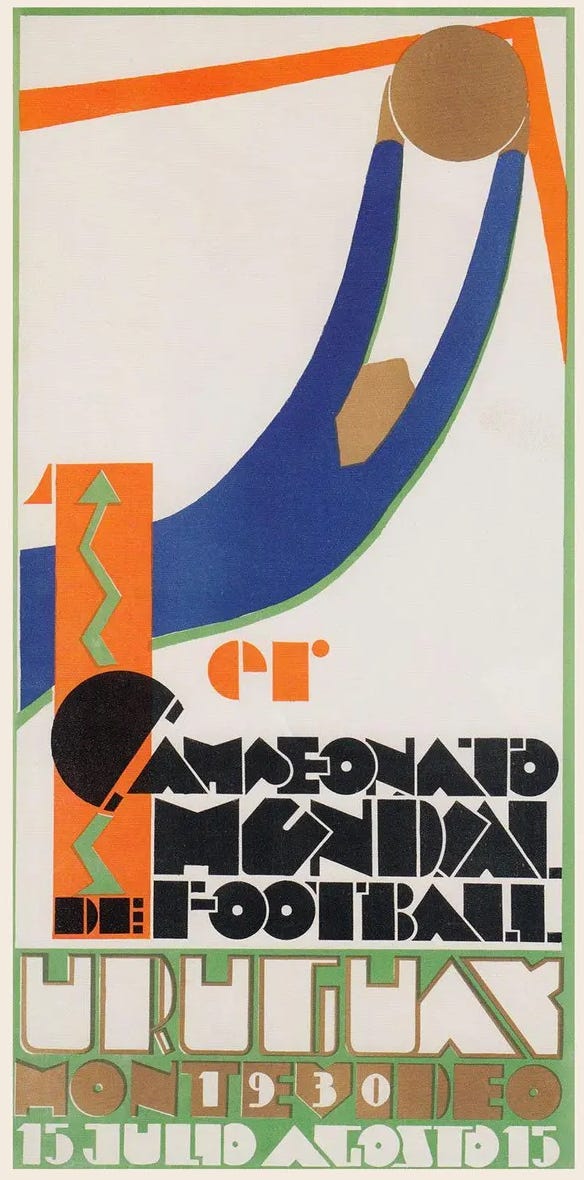
Third, the event that kicks off on June 11 is the finals of the World Cup, a tournament that has been contested among 211 FIFA member nations since 2023. The terminology is a bit confusing, I agree, because in casual usage “the World Cup” starts on June 11 and culminates in “the World Cup final” on July 19, after more than 100 matches in “the finals.”
How I am such a relative insider to little details such as these? Me, a mere American?
And what does any of this have to do with my interests in institutions and governance of complex systems?
Here we go:
I am a member of that tiny community of suburban Americans who got their start in competitive soccer in the late 1960s. I was in the second grade, I think, when I first put on a soccer jersey and took up a post as what was then called “a fullback.”
I have no idea how many of that community are still alive today, but I once figured out that around that time there could not have been more than about 100,000 kids - almost all of them boys - playing organized youth soccer in the US in 1970 outside of social clubs anchored in immigrant communities (Italian, Irish, German, Greek, Mexican, Dutch, and English, at least based on people I played with or met as coaches) and the occasional group of children of non-US-born graduate students at the local university.
My family organized one of the first two AYSO (American Youth Soccer Association) teams in Menlo Park, California. (AYSO, known for the motto “Everyone plays,” was founded by German expats in Southern California in 1964.) We were the "Pythons,” and like all of the teams in our little Mid-Peninsula league, we wore uniforms that were modeled after the uniforms of English First Division teams. Our black and orange resembled Hull City. I regularly wore uniforms of various colors and designs until my late 20s; the last time I pulled on a shirt was (only) about 20 years ago. I have a winner’s medal from a statewide California U-19 competition from the late 1970s. A college coach watched me play a match during my senior year of high school and included me in the “recruited players” practice when I showed up on day 1 of my freshman Fall. (I did not stick it out. This incredibly talented player was also in that group. I had better things to do with my time in college than watch him run past me and score goals!) I played briefly with the father of Diego Luna, today one of the stars of Major League Soccer (and, puzzlingly, omitted from the US team that will compete in the World Cup finals). I have the scars that give me an insider’s knowledge into traumatic knee injuries experienced on the soccer field.
Beyond my playing (and my brother played, too), we were part of “soccer world.” Our family were original (1974) season ticket holders of the NASL San Jose Earthquakes. I participated in the “Stanford Soccer Camp” for several years, when that program was simply for kids who wanted to learn to play and play better, and I attended a sleepaway soccer camp (a novelty at the time) at UC Santa Cruz in 1975, where the guest coach was Paul Child, then the Earthquakes’ star striker and later a star for the indoor Pittsburgh Spirit. (Paul settled in Pittsburgh after he retired, and because of his contributions to Pittsburgh soccer and to the Pittsburgh Riverhounds, last year’s USL Championship winners, the supporters’ stand in the Riverhounds’ stadium is named for him.) The coaching staff at that camp were so taken by Paul that they jokingly promised to call him out from the stands when they took the campers to a Quakes match. I remember hearing them shout “give us a game, Paul!” when he took the field that night. My father immersed himself deeply in youth coaching, refereeing, freelance soccer writing, and community organizing. Through his connections, I watched the opening match of Major League Soccer in 1996 - San Jose Clash 1, DC United 0, and thank YOU Eric Wynalda, who scored that goal! - from the owners’ box at the old Spartan Stadium.
So much throat clearing.
Now, the points, more or less:
Soccer is an institution of institutions, constructing and evolving through intersecting and overlapping tiers and layers of forms, practices, rules, and social norms. I explained that claim at great length once in an academic article about soccer and soccer refereeing. My point was partly about soccer itself and party about soccer as a case study of evolving institutional governance. (I wrote about it here, at this very newsletter, a while back.) For a much shorter, more fun, and less academic version of the same idea, see this little piece about the history of the soccer ball.
Soccer’s “polycentric” institutional context stretches far and wide: from the 19th century factories of Scotland and Northern England to English public schools to the English colonies that received versions of the game that were carried by English civil servants and that were rooted eventually, locally, in neighborhoods and communities from the southern-most tips of Africa and South America to the northern-most reaches of Scandinavia and essentially all points in between. Today, multiple generations onward, whether it is one person knocking a ball against a wall or multi-millionaires hashing it out in the final of the Champions League, soccer is not simply “the beautiful game” (if not always beautiful, in practice); it is something close to a universal language. Combine a human or two (or perhaps … robots?), a round object of a certain size, and a reasonably flat, stable surface. That’s all one needs to join in the play, or to have a focus for a chat (and a debate!).
Soccer is essentially universal, but it has an almost endless number of local variations, “local” meaning historical setting; neighborhood and town; age, gender, and ability; nation and region; and on the field (pitch), in the stands, in the streets and over the last 20-plus in streets and “fan zones” adjacent to major tournament matches, and in bars, restaurants, and homes. Watch for the Dutch “Orange Bus” coming to Kansas City.
Which means that to me, the fascinating and fantastic “thing” about soccer is not simply dissecting chances made and chances missed, or coaching tactics, or refereeing errors, bungled penalty kicks, chronic disappointment (the Dutch, again and again, and the English, since 1966), or the corruption and other self-dealing on abundant display at FIFA and regional and national soccer federations. The fascinating and fantastic thing is the unrelenting passion that institutional drama has not and seemingly cannot extinguish, both on and off the field. The best of soccer on the field lies in the players’ freedom to imagine collectively and individually. The best of soccer off the field lies in fans, supporters, and broader communities borrowing that freedom and blending it with their own, both in their attention to the game itself and also in their incorporating their attachment to soccer into their building and reinforcing their local, regional, national, and other identities and histories.
To illustrate:
In 1994, I had the very good fortune to go to a number of World Cup matches in the US, including the final in the Rose Bowl. (With my friend Adam, I sat more or less behind the goal where the teams faced off via penalty kicks. I won’t say that Baggio and Baresi put their shots over our heads, but I don’t say that they did not.) I sat with and walked with members of soccer cultures from all over the planet.
I was in the stands at Stanford Stadium on July 4, 1994 to watch the US play Brazil, along with more than 80,000 other people.
As much as I enjoyed the thousands of Brazilian supporters drumming and samba-ing for well over 90 minutes (because the drumming and dancing began in the streets outside the stadium before the match, and continued well afterward), the greatest display of unexpected and extraordinary soccer commitment that I have witnessed was during a different 1994 World Cup match: a group match between Cameroon and Russia.
Competitively, the match was far from compelling. Both teams were already out of the tournament. Still, Russia played aggressively and won, 6-1. Five Russia goals were scored by a single player (Salenko), a record. The legendary Roger Milla, hero of Cameroon’s 1990 team, scored his team’s only goal (also a record, as Milla extended his run as the oldest player to score in a World Cup finals).
But what caught my attention wasn’t the play on the field. I happened to be sitting in an “open” part of the press building that rose about the West side of the old Stanford Stadium. We were not in a private box; we were not in the press box itself. But we were seated adjacent to a section of Cameroon fans. Not any Cameroon fans. These were wealthy, elite Cameroons: dressed to the proverbial and oh-so-beautifully colorful nines, and who conducted themselves before the game with the grace that one stereotypically associates with any country’s elite.
And during the match, these people - to a person - went absolutely nuts. Men. Women. All ages. Standing, screaming, waving arms. I’ve been in European soccer stadiums where ultras sing and chant in coordinated rhythms for 90 minutes, and those fans had absolutely nothing on the high-end Cameroons that I witnessed in 1994.
And it was glorious.
How much of this will return to the US this year? What about the Dutch fans? The Scots? The Argentines? The Moroccans? The Haitians?
Late last year - November 2025 - at a college football tailgate I met the mother of one of the players in that day’s game, a woman who mentioned that she was raised in Haiti. “Haiti!,” I replied, “Haiti has qualified for the World Cup finals!” The woman’s smile broadened into an enormous grin, and she extended her joy immediately by wrapping me in a bear hug. Few soccer fans think “Haiti” when they think of signature national teams, but clearly, to many Haitians and people of Haitian descent, soccer is intimately connected to national identity. And that’s the point. Ted Lasso’s Dani Rojas was not wrong: football really is life.
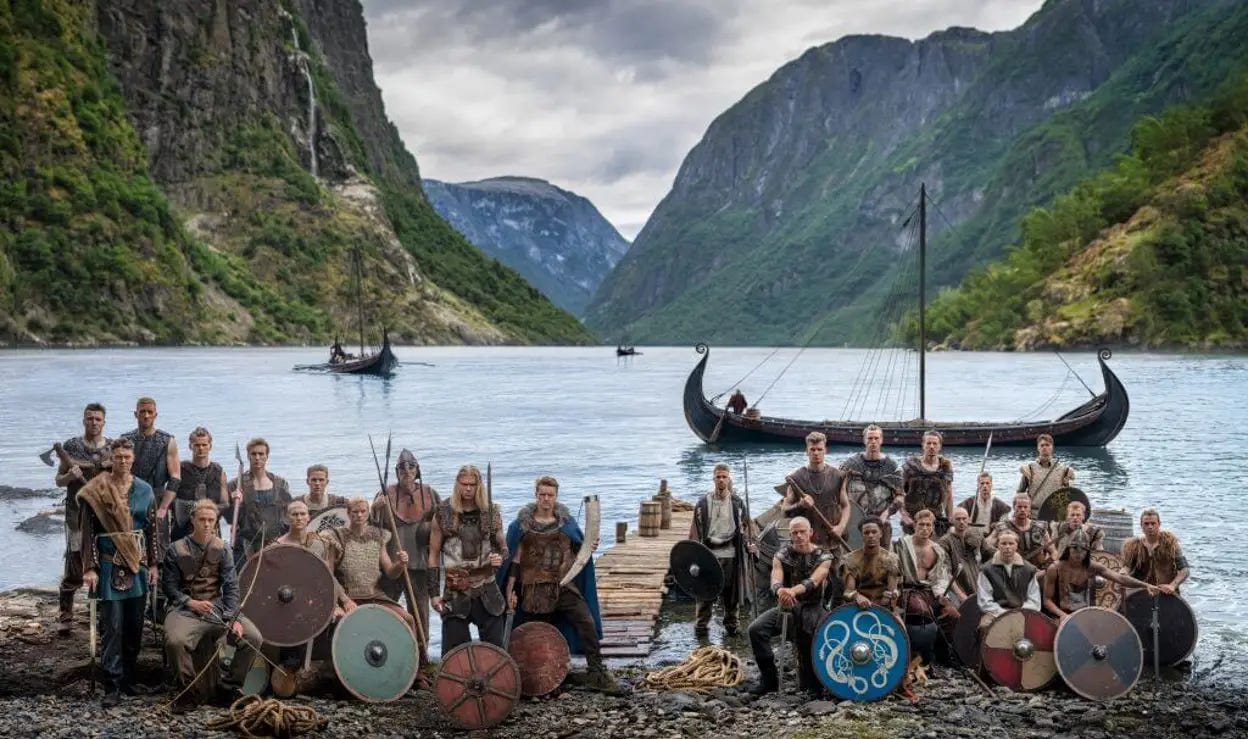
The Norwegians? Judging from their new team photo, Norway is bringing an old-time Scandinavian swagger to North America. Real Vikings!
Will US Men’s National Team fans find their own voice, literally and metaphorically speaking?
I don’t know. The American Outlaws supporters’ group will certainly give it a go, but even a lot of American soccer fans aren’t familiar with the Outlaws.
I do know that media stories wondering whether soccer’s time has finally come in the US are missing the mark. US sports media and, by extension, casual sports fans in the US, have come to treat organized sports mostly as entertainment. It’s commerce. The game is a product, on the field and on the screen. The media want to know: when will US soccer be big business? The implication often being that US competitive success and cultural salience will follow once the right sort of industrial/commercial enterprise is built around the game.
But inside the US, that hasn’t been the story of soccer over the last 30 years, and outside of the US, that’s not the history of soccer, even if in some countries and some professional leagues, it is increasingly (and unfortunately) the practice.
Instead, the passion that has built soccer over well over a century and around the world, and the passion that fascinates me, is the passion that emanates from the intersection of organized activity (institutions) anchored in history and community - much like baseball once was, in the US, and still is in places.
That passion has long existed in the US, even for soccer. The Athletic, connected to the New York Times, had a terrific piece the other day that explored the history of American soccer’s original and longest-standing journalistic institution: Soccer America, originally known as Soccer West. That took me back. Once upon a time, as a middle schooler, somehow I got roped into an afternoon in the stands at a high school stadium in Cupertino, California, selling copies of Soccer West to the smattering of family and friends who were there to watch a youth soccer match. I think that each copy cost 35 cents; I got to keep a dime per each one I sold.
Between suburban soccer in the US and the even longer history of soccer in immigrant communities - near me, in Pittsburgh, the Beadling club has long been one of the elite youth soccer programs in the US; it began as a social club for Italian coal miners and their families - no one who cares about soccer in the US today should be wondering: how do we turn Major League Soccer into a rival of Major League Baseball or the National Basketball Association? Instead, they should be studying the history of soccer passion in the US and how that passion has been “institutionalized” per the “polycentric” framing that my academic self tried to capture in the articles I pointed to above.
In other words, where we have seen soccer grow and stabilize around the US, where we have seen Major League Soccer find its feet, and where we have seen other professional leagues grow and thrive (including the USL Championship), and with the women’s game, institutional equilibria have been established around local communities of players, families, and supporters.
NFL owners and some players have gotten rich selling soap - a product, known as “football” - to willing and persuadable consumers. In all but a handful of cases (Pittsburgh, interestingly, being one of these handful), community identity has been manufactured around the club and the sport. (I witnessed this living in the San Francisco Bay Area during the Brodie-to-Young 49er years.) Internationally, soccer has edged in that direction, especially as Premier League clubs have built fan bases in Asia and in Africa and as the Saudi government has (tried to) build a soccer identity in Saudi Arabia. But that success may prove to be unstable. Durability starts on the ground. Build locally. Bottom up, everyone.
Bonus note: my two favorite players of all time are Franz Beckenbauer (I got to see him play in person once; I was on the sideline for a Cosmos match against the Oakland Stompers, in 1978) and Michelle Akers. Der Kaiser, and Mufasa.
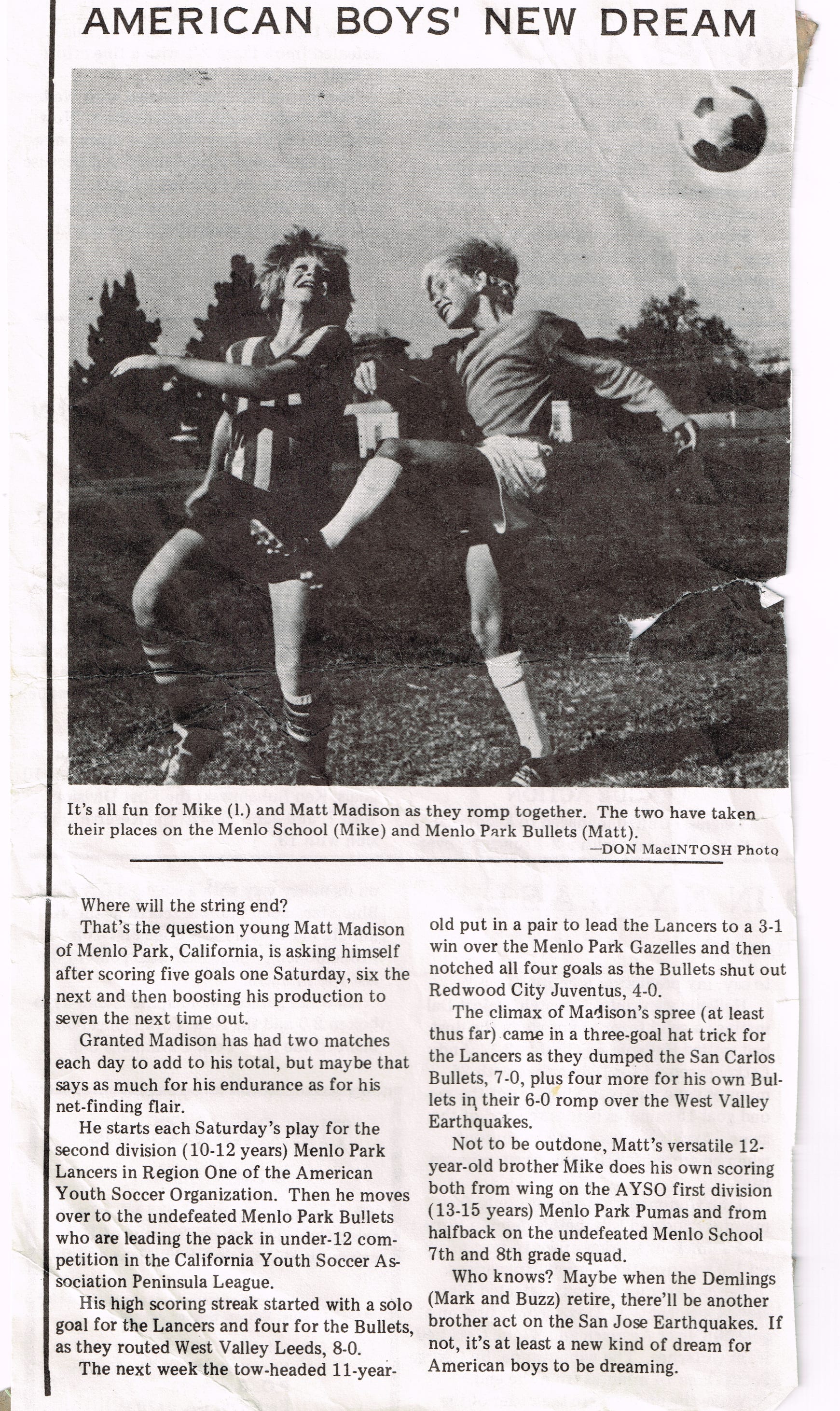
I’ll leave you all with this. I was in Soccer America once. In 1974. My younger brother and I were featured in a short piece on our playing for multiple teams at the same time, and scoring goals by the bucket-ful. As recently as 50 years ago, soccer in the US was simultaneously the NASL, which was a sort-of professional league, and notes in a local newsletter.
To sum up, borrowing Ian Darke’s great call from 2010: